Tennessee Mall and Shopping Center Slip and Falls
If you slipped and fell at a Tennessee mall or shopping center, your claim comes down to one question: did the property owner know, or should it have known, about the hazard before you fell? Tennessee law requires you to show either that the owner or its employees created the dangerous condition, or that the owner had actual or constructive notice of it. Proving notice is where these cases are won and lost, and Tennessee gives you more than one way to do it.
Malls and shopping centers add a wrinkle most people miss. Several different companies may share responsibility for the exact spot where you fell.
Table of Contents
What Do You Have to Prove?
A Tennessee premises liability claim requires the standard negligence elements plus one of the following:
- The owner or its employees created the dangerous condition, or
- If a third party created it, the owner had actual or constructive notice that the condition existed before your fall
Actual notice means someone knew. An employee saw the spill, a customer reported it, or a manager was told about the broken tile.
Constructive notice means the owner should have known. Tennessee recognizes two separate paths to constructive notice:
- Length of time. The condition existed long enough that a reasonably careful owner should have discovered it.
- Pattern or recurring condition. In Blair v. West Town Mall, 130 S.W.3d 761 (Tenn. 2004), the Tennessee Supreme Court held that a plaintiff may establish constructive notice by showing a pattern of conduct, a recurring incident, or a general or continuing condition indicating the dangerous condition’s existence.
Blair itself involved a woman who fell on slick oil spots in a mall parking lot, where buses regularly dropped off customers in that area. The Tennessee Supreme Court reaffirmed this framework in Parker v. Holiday Hospitality Franchising, Inc., 446 S.W.3d 341 (Tenn. 2014).
That second path is powerful. You do not necessarily have to prove how long your puddle sat there if you can show the problem kept happening in that spot.
Who Is Responsible in a Mall?
This is where these cases differ from a fall in a standalone store. Responsibility may be split among:
- The mall owner or property management company, typically responsible for common areas
- The individual tenant store, responsible for the area inside its lease
- A janitorial or maintenance contractor under contract for cleaning and inspections
- A snow and ice removal contractor for exterior areas
- An anchor store, which sometimes controls portions of the parking lot under its lease
Where exactly you fell can determine who is liable. A fall five feet inside a store entrance and a fall five feet outside it may involve entirely different defendants. Lease agreements and maintenance contracts, obtained during the case, sort this out.
What Hazards Cause These Falls?
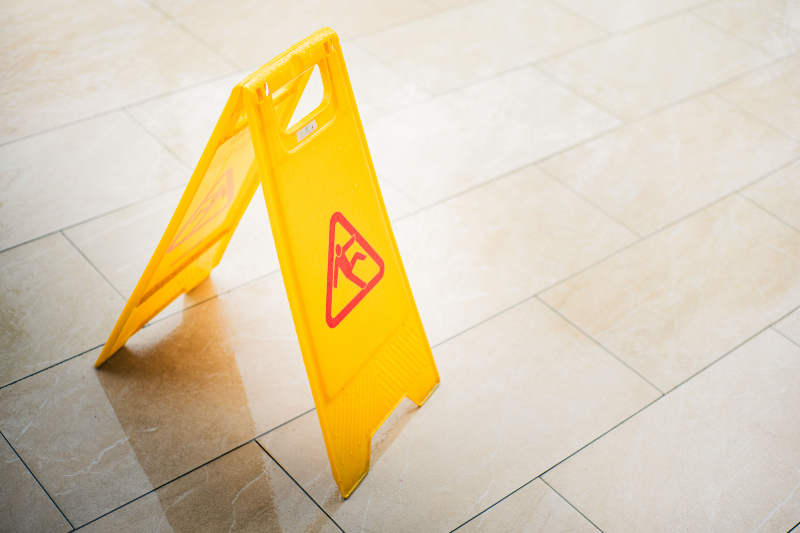
- Wet floors from spills, tracked-in rain, leaks, or recent mopping without warning signs
- Freshly waxed or polished floors with no notice
- Food court spills in high-traffic areas
- Torn carpet, curled mats, or uneven transitions between flooring types
- Broken or missing tiles
- Escalator and elevator malfunctions
- Parking lot potholes, cracked pavement, and wheel stops
- Ice and snow accumulation at entrances and in lots
- Poor lighting in garages and stairwells
- Missing handrails on stairs and ramps
Entrances during rain deserve particular attention. Tracked-in water is entirely predictable, which is exactly the kind of recurring condition Blair contemplates.
What Evidence Should You Gather?
Move quickly. Retail video systems overwrite on short cycles.
- Photograph the hazard immediately, before anyone cleans it up
- Photograph your footwear to head off a defense argument about your shoes
- Report the fall to store or mall management and request a written incident report
- Get the report number and the name of the person who took it
- Identify witnesses, including employees who responded
- Request video preservation in writing to both the store and mall management
- Seek medical care the same day
- Keep the clothing you were wearing if it shows the substance you slipped on
Later, through the legal process, a lawyer can obtain inspection logs, sweep sheets, prior incident reports for that location, and maintenance records. Prior incidents at the same spot are what turn a routine claim into a strong one.
Will They Blame You?
Expect it. Common defenses:
- Open and obvious. The hazard was visible and you should have avoided it.
- Comparative fault. You were distracted, on your phone, or wearing unsafe footwear.
- No notice. The spill happened moments before and nobody could have caught it.
Tennessee’s modified comparative fault rule means you can recover as long as your share of fault is under 50 percent, with your award reduced by your percentage. Being partly distracted does not end a claim against a store that let a puddle sit for an hour.
What Compensation Is Available?
- Economic damages with no cap: emergency care, surgery, physical therapy, and lost income
- Noneconomic damages for pain and suffering, capped at $750,000, or $1 million for catastrophic injuries
- Punitive damages in cases of reckless disregard for safety
Falls commonly produce fractures, torn rotator cuffs, herniated discs, and head injuries. Older adults face particularly serious consequences from a broken hip.
FAQs
What if I did not report the fall that day?
You can still have a claim, but it is harder. Report it as soon as possible in writing and gather photos, receipts, and witness information to establish when and where it happened.
Do I have to prove how long the spill was there?
Not necessarily. Tennessee also allows constructive notice through a pattern of conduct, a recurring incident, or a continuing condition under Blair v. West Town Mall.
Does a wet floor sign defeat my claim?
Not by itself. The question is whether the warning was adequate, placed properly, and actually visible to someone approaching the hazard.
How long do I have to file in Tennessee?
Generally, one year from the fall under Tennessee Code Section 28-3-104.
Fell at the Mall and Getting the Runaround?
Being told “we have no record of that” is a common experience, and it is a reason to act quickly rather than a reason to give up. The incident reports, sweep logs, and prior complaints all exist somewhere, and they can be obtained.
The Higgins Firm handles slip and fall and premises liability claims across Tennessee. Use our contact page for a free case review.
Author Bio

Jim Higgins, founder of the Higgins Firm, is a seasoned personal injury attorney with deep roots in Nashville, Tennessee. A 4th generation Nashvillian, Jim carries on the legal legacy of his father, a judge for over 30 years. After graduating from the University of Memphis School of Law, Jim’s career began on the other side of the courtroom, defending insurance companies and learning their tactics for minimizing settlements. However, he soon realized his true calling was fighting for the rights of the injured, and for the past several years, he has exclusively represented plaintiffs in personal injury cases.
Since then, his dedication and skill have earned him membership in the prestigious Million Dollar Advocates Forum, an organization limited to attorneys who have secured million and multi-million dollar verdicts and settlements for their clients. Licensed to practice in Tennessee, Kentucky, and Georgia, Jim focuses on personal injury, product liability, medical malpractice, and workers’ compensation cases. His exceptional work has been recognized by his peers, earning him a spot on the Super Lawyers list from 2021 to 2024, a distinction awarded to only a select group of accomplished attorneys in each state.