Tennessee Lane Change Accident Fault
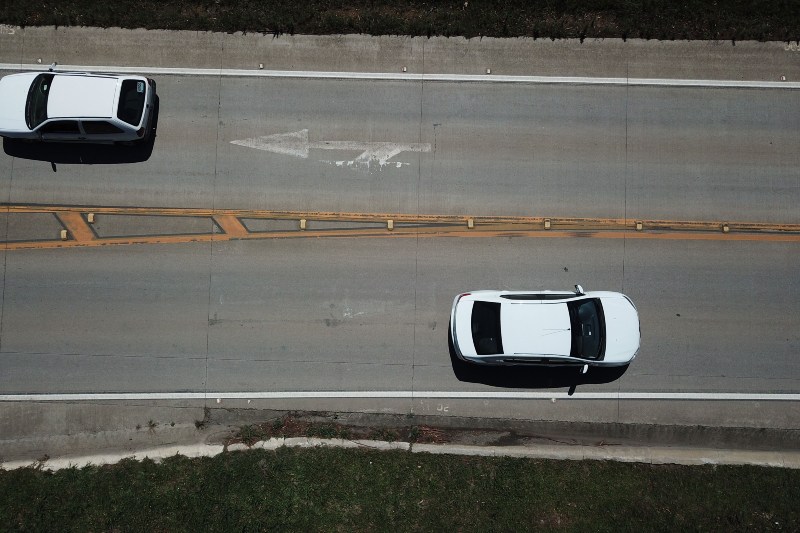
In a Tennessee lane change accident, fault usually falls on the driver who left their lane. State law puts the burden squarely on that driver: a vehicle must stay as nearly as practicable entirely within a single lane, and it cannot leave that lane until the driver has first ascertained that the movement can be made with safety. A driver who merges into an occupied lane has usually violated that duty. Fault can still be shared, though, because Tennessee compares each party’s percentage of responsibility.
Sideswipe and merge crashes generate more fault disputes than almost any other collision type, because both cars were moving and each driver saw something different.
Table of Contents
What Does Tennessee Law Require Before a Lane Change?
Two statutes control.
Tennessee Code Section 55-8-123 covers driving on roadways laned for traffic. It requires that a vehicle be driven as nearly as practicable entirely within a single lane and not be moved from that lane until the driver has first ascertained that the movement can be made with safety.
Tennessee Code Section 55-8-143 covers signals. Every driver who intends to start, stop, turn, or partly turn from a direct line must first see that the movement can be made in safety, and must signal whenever another vehicle may be affected by the movement. The statute also says a driver who has given a signal must continue the course indicated unless they change the signal and take care that others have seen the change.
Read together, they place three obligations on the merging driver: check first, signal, and only move when it is safe. Violating a safety statute can serve as strong evidence of negligence.
Who Is Usually at Fault?
The merging driver, in most cases. The driver traveling straight in an established lane generally has the right of way.
Typical causes:
- Blind spot failures, where the driver checked mirrors but never looked
- No signal, or a signal given at the same instant as the move
- Distraction, including phone use during the merge
- Aggressive weaving through traffic
- Misjudging speed and distance of a vehicle already in the lane
- Drifting from drowsiness or impairment
- Merging into a blind spot near a large truck
Large trucks deserve separate mention. Their blind spots are enormous, and a merge across one can be catastrophic. Truck accident claims often add federal safety regulations and carrier records to the analysis.
When Can the Other Driver Share Fault?
Fault is rarely all-or-nothing in these cases. Insurers look for reasons to shift some responsibility to you, including:
- Speeding, which shrinks the gap the merging driver was judging
- Accelerating to close a gap rather than allowing the merge
- Being in a blind spot and staying there
- Simultaneous lane changes, where both cars moved into the same lane at once
- Driving without headlights in low visibility
- Distraction on your part
Under Tennessee’s modified comparative fault rule, you can recover as long as your share is less than 50 percent, and your award is reduced by your percentage. If a jury values your damages at $200,000 and finds you 20 percent at fault, you recover $160,000. At 50 percent or more, you recover nothing, which is exactly why insurers push these arguments hard.
What Evidence Settles the Dispute?
Sideswipe cases hinge on physical proof, because both drivers usually claim the other one moved.
- Damage patterns and paint transfer. The location, angle, and direction of scraping often reveal which vehicle was crossing the line.
- Vehicle event data. Onboard recorders can show speed, steering input, and braking in the seconds before impact.
- Dashcam footage, yours or from a nearby vehicle.
- Traffic and business surveillance video near the crash location.
- Roadway evidence, including scrape marks and debris fields.
- Witness statements from other drivers.
- The crash report, which is a starting point rather than a verdict.
- Phone records, where distraction is suspected.
An accident reconstruction professional can use damage geometry to establish the relative positions of both vehicles at impact. That analysis frequently resolves a he-said-she-said case.
What Should You Do After a Lane Change Crash?
- Call the police and get a report, even for what looks like minor contact.
- Photograph both vehicles, focusing on the full length of the damage rather than just the worst spot.
- Photograph the lane markings and road position before vehicles are moved, if it is safe.
- Note the lane each car was in and the direction of travel.
- Get witness contact information.
- Be careful what you say. Do not speculate about what you did or did not see.
- Get evaluated medically, since sideswipes commonly cause neck, shoulder, and back injuries that surface a day later.
The Tennessee Department of Safety publishes statewide crash data broken down by crash type if you want a sense of how common these collisions are.
What Compensation Can You Recover?
A lane change crash claim can seek:
- Economic damages with no cap: medical bills, future treatment, lost wages, and vehicle damage
- Noneconomic damages for pain and suffering, capped at $750,000, or $1 million for catastrophic injuries
- Punitive damages where conduct was especially reckless, such as impaired or extremely aggressive driving
FAQs
What if both of us changed lanes at the same time?
Fault is usually apportioned between both drivers. Physical evidence and any video become the deciding factors, and each driver may carry a percentage.
Does not signaling automatically make someone at fault?
Not automatically, but failing to signal when another vehicle may be affected violates Tennessee Code Section 55-8-143 and is strong evidence of negligence.
The other driver says I was in their blind spot. Does that matter?
It can affect the percentages, but the merging driver still had a duty to make sure the move could be made safely before making it.
How long do I have to file?
Generally, one year from the crash under Tennessee Code Section 28-3-104.
Sideswiped and Being Blamed for It?
These cases turn on scrape direction, paint transfer, and vehicle data rather than on who tells the better story to an adjuster. That evidence exists right after the crash and disappears once both cars are repaired.
The Higgins Firm handles car accident claims across Tennessee, including disputed-fault sideswipe and merge collisions. Use our contact page for a free case review.
Author Bio

Jim Higgins, founder of the Higgins Firm, is a seasoned personal injury attorney with deep roots in Nashville, Tennessee. A 4th generation Nashvillian, Jim carries on the legal legacy of his father, a judge for over 30 years. After graduating from the University of Memphis School of Law, Jim’s career began on the other side of the courtroom, defending insurance companies and learning their tactics for minimizing settlements. However, he soon realized his true calling was fighting for the rights of the injured, and for the past several years, he has exclusively represented plaintiffs in personal injury cases.
Since then, his dedication and skill have earned him membership in the prestigious Million Dollar Advocates Forum, an organization limited to attorneys who have secured million and multi-million dollar verdicts and settlements for their clients. Licensed to practice in Tennessee, Kentucky, and Georgia, Jim focuses on personal injury, product liability, medical malpractice, and workers’ compensation cases. His exceptional work has been recognized by his peers, earning him a spot on the Super Lawyers list from 2021 to 2024, a distinction awarded to only a select group of accomplished attorneys in each state.